Monday, 6 July 2015

Thekkady


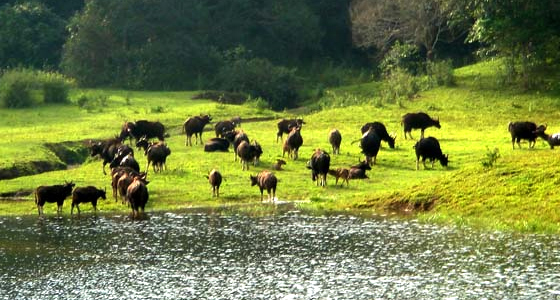
Thekkady is probably the best place in Kerala to observe wildlife and hence its a dream destination for any tourist visiting Kerala.From the mighty Indian elephant to the Great Indian Tiger ,this place  has it all.Elephants, Deers,boars,bisons and lion tailed macaques are a common sight in the reservoir area.

Main Activities Near By:
  • Nature Walk in Periyar Tiger Reserve:
Nature Walk is an interpretive sandal protection trekking programme offering excellent opportunity of watching birds, butterflies and other wildlife through a range of habitats during the 4-5 km 3-hours walk.

Munnar

Munnar is Known as Kashmir of South India & its situated in Kerala. Munnar is located at an altitude of 1600 feet above sea level. It is one of the attractions that contributed to Kerala’s popularity as a travel destination among domestic and foreign traveler's snuggled in the lap of such an alluring terrain, Munnar is one of the most beautiful hill stations in Kerala.
Main Attractions in And Around Munnar
  • Eravikulam National Park:
Eravikulam National Park is located along the Western Ghats in the Idukki district of Kerala. The Western Ghats, Anamalai Sub-Cluster, including all of Eravikulam National Park, is under consideration by the UNESCO World Heritage Committee for selection as a World Heritage Site.
  • Indo Swiss Dairy Farm:
Mattupetti Indo Swiss farm is open from morning to evening for the tourists to visit it. This farm is well looked after, as it is abundantly rich in nature. In fact, it is believed to be the nature’s paradise with Mattupetti Lake being snuggled close on the Idukki hills, which is extraordinarily a nature opulent district of Kerala. Cochin international airport is the nearest airport at a distance of 130 km, the Kottayam railway station is 142 km from Munnar and Mattuppetti is 13 km from Munnar by road.
  • Chinnar Wild Life Sanctuary:
The Chinnar Wildlife Sanctuary is located in the rain shadow region of Western Ghats of Kerala, India., and represents a large number of plants and animals unique to the thorny vegetation. Apart from the dry thorn forests, due to the significant variation in altitude and rainfall, it has a wide array of habitat types like deciduous forests, dry thorny forest,riparian types, sholas and grasslands that are interspersed with plains, hillocks, rocks and cliffs which provide micro habitats for varied forms of life.
  • Anamudi:
The highest peak (2695 m) south of the Himalayas, towers over the sanctuary inmajestic pride. The slopes of the hills abound in all kinds of rare flora and fauna.The Atlas moth, the largest of its kind in the world, is a unique inhabitant of the park. Other rare species of fauna found here are the Nilgiri Langur, the lion-tailed macaque, leopards, tigers, etc.
  • Tata Tea Museum:
The museum is located at the Nallathanni Estate of Tata Tea in Munnar and is worth a visit. Munnar has a legacy of its own when it comes to the origins and evolution of tea plantations. Taking account of this legacy and to preserve and showcase some of the exquisite and interesting aspects on the genesis and growth of tea plantations in Kerala’s high ranges, a museum exclusively for tea was opened some years ago by Tata Tea in Munnar. This Tea Museum houses curios, photographs and machineries; all of which have a story to tell on the origins and growth of tea plantations in Munnar.Not only this, but much more about what all you desire for you perfect vacations or honeymoon, can be availed here. The best nature speckled beauty, long natural walks, drives, romance and grandeur will make your trip an ideal one.
  • Idukki Arch Dam:
Idukki Arch Dam is the world’s second and Asia’s first arch dam, constructed across the Kuravan and Kurathi hills. 550 ft. high and 650 ft. wide, the dam lies close to the Cheruthoni barrage. To its west is the Kulamavu Dam. Idukki Wildlife Sanctuary is located close by. This prestigeous project of our nation is situated in Idukki District and its underground Power House is located at Moolamattom which is about 19 kms from Thodupuzha.

Thursday, 2 July 2015

Paradesi Synagogue


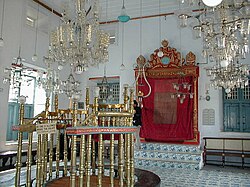
Jewish synagouge kochi india.jpg

The Paradesi Synagogue is the oldest active synagogue in the Commonwealth of Nations, located in Kochi, Kerala, in South India. Constructed in 1567, it is one of seven synagogues of the Malabar Yehudan people or Cochin Jewish community in the Kingdom of Cochin. Paradesi is a word used in several Indian languages, and the literal meaning of the term is "foreigners", applied to the synagogue because it was built by Sephardic or Spanish-speaking Jews, some of them from families exiled in Aleppo, Safed and other West Asian localities. It is also referred to as the Cochin Jewish Synagogue or the Mattancherry Synagogue.

The synagogue is located in the quarter of Old Cochin known as Jew Town, and is the only one of the seven synagogues in the area still in use. The complex has four buildings. It was built adjacent to the Mattancherry Palace temple on the land given to the Malabari Yehuden community by the Raja of Kochi, Rama Varma. The Mattancherry Palace temple and the Mattancherry synagogue share a common wall.

History

The Malabari Jews (also known as Cochin Jews) formed a prosperous trading community of Kerala, and they controlled a major portion of world wide spice trade. In 1568, the Jews of Kerala constructed the Paradesi Synagogue adjacent to Mattancherry Palace, Cochin, now part of the Indian city of Ernakulam, on land given to them by the Raja of Kochi. The original synagogue was built in the 4th century in Kodungallur (Cranganore) when the Jews had a mercantile role in the South Indian region (now called Kerala) along the Malabar coast. When the community moved to Kochi in the 14th century, it built a new synagogue there.

The Malabari Jews' first synagogue in Cochin was destroyed in the 16th century by the Portuguese persecution of the Jews and Nasrani people. The second, built under the protection of the Raja, in Mattancherry, in 1558, during the Portuguese rule of Cochin, is the present synagogue, which is still in use for worship and can attract a minyan. It is called Paradesi synagogue because it was built by Spanish speaking Jews; this contributed to the informal name: paradesi synagogue or "foreign" synagogue." In addition, a new Jewish group had immigrated to Kochi, Sephardim from the Iberian Peninsula. They and the Malabari Jews shared many aspects of their religion, and the newcomers learned the Judeo-Malayalam dialect, but the Sephardim also retained their own culture and Spanish language at least for three centuries. By 1660 the Dutch ruled the Kochi area, calling it Dutch Malabar. In later years, the Paradesi Synagogue was used primarily by the Sephardim (who were also referred to as Paradesi) and their descendants, and later European exiled Jews.

The Paradesi Synagogue had three classes of members:

    White Jews were full members. The White Jews, or Paradesi Jews, were the recent descendants of Sephardim from Spain and the Netherlands.
    Black Jews, or Malabari Jews, were allowed to worship but were not admitted to full membership. These Cochin Jews were the original Jewish settlers of Cochin.
    Meshuchrarim, a group of freed slaves and their descendants brought by the Sepahardim, they had no communal rights and no synagogue of their own. They sat on the floor or on the steps outside. In the first half of the 20th century, Abraham Barak Salem, a meshuchrar, successfully campaigned against this discrimination.

In 1968, the 400th anniversary of the synagogue was celebrated in a ceremony attended by Indira Gandhi, the Indian Prime Minister.

Present

As is customary for Orthodox Jewish synagogues, the Paradesi Synagogue has separate seating sections for men and women.

Today the Paradesi Synagogue is the only functioning synagogue in Kochi with a minyan (though this minyan must be formed with Jews from outside Kochi, as the number who still reside there is not sufficient). In conformity with the Hindu, Nasrani and Islamic traditions of Kerala, the worshippers are required to enter the Paradesi Synagogue barefoot.[3] Other facets which are unique to the Cochin Jewish community, and which are results of Hindu influence, include special colors of clothing for each festival, circumcision ceremonies performed at public worship, and distribution of grape-soaked myrtle leaves on certain festivals. In addition, the Cochin Jews have no rabbis, and the community is led by elders.

The synagogue is open for a fee to visitors as a historic attraction. The ticket-seller, Yaheh Hallegua, is the last female Paradesi Jew of child-bearing age.

Objects of antiquity

The Paradesi Synagogue has the Scrolls of the Law, several gold crowns received as gifts, many Belgian glass chandeliers, and a brass-railed pulpit. It houses the 10th-century copper plates of privileges given to Joseph Rabban, the earliest known Cochin Jew. These two plates were inscribed in Tamil by the ruler of the Malabar Coast. The floor of the synagogue is composed of hundreds of Chinese, 18th-century, hand-painted porcelain tiles, each of which is unique. A hand-knotted oriental rug was a gift from Haile Selassie, the last Ethiopian emperor. The synagogue has an 18th-century clock tower, which, along with other parts of the complex, was restored between 1998 and 1999 under the direction of the World Monuments Fund.

A tablet from the 1344 synagogue in Kochangadi in Kochi was installed on the outer wall of the Paradesi synagogue. The inscription states that the structure was built in 5105 (in the Hebrew Calendar) as "an abode for the spirit of God."

Thekkumbhagom synagogue

The Thekkumbhagom synagogue, located on Jews Street in the Ernakulam area of Cochin, was built in 1580 and renovated in 1939.
Vembanad


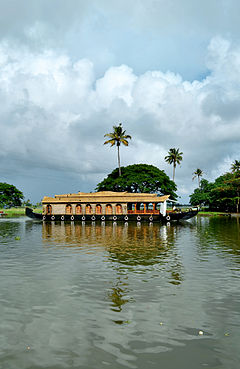
House Boat DSW.jpg

Vembanad (Vembanad Kayal or Vembanad Kol) is the longest lake in India, and the largest lake in the state of Kerala. It is also counted as one of the largest lakes in India. Spanning several districts in the state of Kerala, it is known as Punnamada Lake in Kuttanad, Kochi Lake in Kochi. Several groups of small islands including Vypin, Mulavukad, Vallarpadam, Willingdon Island are located in the Kochi Lake portion. Kochi Port is built around the Willingdon Island, and the Vallarpadam island.

The Nehru Trophy Boat Race is conducted in a portion of the lake. High levels of pollution have been noticed at certain hotspots of the Vembanad backwaters. Government of India has identified the Vembanad wetland under National Wetlands Conservation Programme.

Geography and hydrography
Location in Kerala

The Vembanad wetland system covers an area of over 2033.02 km²  thereby making it the largest wetland system in India. Of this, an area of 398.12 km² is located below the MSL and a total of 763.23 km² area is located below 1 m MSL. The lake is bordered by Alappuzha, Kottayam, and Ernakulam districts. It is situated at the sea level, and is separated from the Arabian Sea by a narrow barrier island. Canals link the lake to other coastal lakes in the north and south. The lake surrounds the islands of Pathiramanal, Perumbalam and Pallippuram. The Vembanad Lake is approximately 14 kilometres wide at its widest point. The lake is a part of Vembanad-Kol wetland system which extends from Alappuzha in the south to Azheekkode in the north, making it by far, India's longest lake at just over 96.5 km in length. The lake is fed by 10 rivers flowing into it including the six major rivers of central Kerala namely the Achenkovil, Manimala, Meenachil, Muvattupuzha, Pamba and Periyar. The total area drained by the lake is 15,770 km², which accounts for 40% of the area of Kerala. Its annual surface runoff of 21,900 Mm accounts for almost 30% of the total surface water resource of the state.

The lake has become a major tourist location in the past few years[when?] thanks to its scenic beauty. The most popular location on the shores of the lake is the Kumarakom Tourist Village situated on the east coast of the lake. The Kumarakom Bird Sanctuary is located on the northern fringes of Kumarakom village. The Vembanad Wetland system was included in the list of wetlands of international importance, as defined by the Ramsar Convention for the conservation and sustainable utilization of wetlands in 2002. It is the largest of the three Ramsar Sites in the state of Kerala. Vembanad lake has been heavily reclaimed over the course of the past century with the water spread area reducing from 290.85 km² in 1917 to 227 km² in 1971 and 213.28 km² in 1990. In the same period almost 63.62 km of erstwhile water spread were reclaimed primarily for formation of polders and to enlarge the extent of the Wellington island of Cochin port. The lake faces a major ecological crisis and has reduced to 37 per cent of its original area, as a result of land reclamation.

A unique characteristic of the lake is the 1,252 metres (4,108 ft)-long Thanneermukkom salt water barrier constructed as a part of the Kuttanad Development Scheme to prevent tidal action and intrusion of salt water into the Kuttanad low-lands. It is the largest mud regulator in India and essentially divides the lake into two parts - one with perennial brackish water and the other with fresh water from rivers draining into the lake. This barrier has helped farmers in Kuttanad by freeing the area of salinity and allowing them an additional crop in the dry season. The Thanneermukkom barrier is located at one of the narrower parts of the Vembanad Lake. Only two-thirds of the original number of gates are opened in July to release flood flow. These gates remain closed until mid-November. The main drawback of the structure has been the loss of opportunity for fish and prawns to migrate upstream, and also an increase in weed growth in the upstream, severely restricting the natural flushing of pollutants. The Thanneermukkom bund has also created ecological problems, primarily, the rampant propagation of the Water Hyacinth in fresh water.

Cities

Over 1.6 million people live on the banks of the Vembanad lake and are directly or indirectly dependent on it for their livelihoods.

The port of Kochi (Cochin) is located at the lake's outlet to the Arabian Sea. The town of Alappuzha (also known as Allepey), sometimes called the "Venice of the East" for its large network of canals that meander through the town - is sandwiched between the lake and the Arabian sea.

Tourism

Vembanad Lake is at the heart of Kerala Backwaters tourism with hundreds of kettuvallams plied on it and numerous resorts on its banks. The Kumarakom Bird Sanctuary is located on the east coast of the lake. The lake has become a major tourist attraction. A generally safe destination, this place was maligned with one incident of tourist harassment in 2004 was reported in The Times of India.

Inland transport

The Vembanad Wetland system has formed an intricate network of estuaries, lagoons and canals which spans over 196 km in the north-south and 29 km in the east-west directions. Almost all villages in these areas can be accessed via water transport. The major rivers of Muvattupuzha, Meenachil, Pamba and Achencovil rivers, are all navigable up to distances of about 30 km upstream in the tidal reach. The Kottappuram-Kollam segment of the west coast canal system has a major chunk passing through the Vembanad Lake and spans a total of 209 km. It has been declared as a National Waterway.

Ecological importance

Vembanad Kol Wetland was included in the list of wetlands of international importance, as defined by the Ramsar Convention for the conservation and sustainable utilization of wetlands.[7] It is home to more than 20,000 waterfowls - the third largest such population in India. It is also an ideal habitat for shrimps.[8] Major livelihood activities of the people living on the shores of the lake include agriculture, fishing, tourism, inland navigation, coir retting, lime shell collection. The uncontrolled mining of shells from the lake bed is also posing a threat to the eco-system. The sewage effluents and the heavy load of organic material released from the neighboring areas including a medical college at Alappuzha is let into the water and are responsible for the decrease in dissolved oxygen content in the water in the water body.

Boat capsize

On July 27, 2002, twenty-nine people were killed when an overcrowded boat capsized in the Vembanad lake. The boat was carrying more people than twice its slated capacity. The boat was a daily ferry service which connects Muhamma village on the west coast to Kumarakom on the east. The crowd were going in for writing a Public Service Commission test which is conducted by government of kerala